
GS Yuasa, Toho Gas, and Hokkaido University Launch Research and Development of Direct Ocean Capture (DOC) Using a Japan-First Technology
September 17, 2026
GS Yuasa Corporation
Toho Gas Co., Ltd.
Hokkaido University
GS Yuasa Corporation (Tokyo Stock Exchange: 6674; “GS Yuasa”), Toho Gas Co., Ltd. (Toho Gas), and Hokkaido University will jointly conduct research and development on power-saving DOC*1 using electrodialysis*2 with hydrogen pumping*3 (hereinafter, “the Research”) through industry-academia-government collaboration.
The Research has been selected for the “Industrial Development of Ocean CDR*4” area under the “Frontier Development” program (hereinafter, “the Program”) of The New Energy and Industrial Technology Development Organization (NEDO), and will be promoted with Hokkaido University as the lead organization.
This is the first time in Japan that electrodialysis with hydrogen pumping has been applied to DOC.
The three parties have each been working on technologies to reduce CO2 emissions toward carbon neutrality. They will now jointly begin research and development of DOC technology to directly capture CO2 from the ocean.
In this Research, electrodialysis with hydrogen pumping will be applied to DOC to reduce the electricity required to extract CO2, thereby lowering the cost of CO2 recovery and aiming for practical implementation. By leveraging Japan’s geographical advantage of being surrounded by the sea on all sides, the three parties will accelerate development through industry-academia-government collaboration toward the social implementation of power-saving DOC technology as a negative emission technology.
The three parties will continue to contribute to the creation of a carbon recycling society through the development of CO2 separation and capture technologies.
Overview of the Research
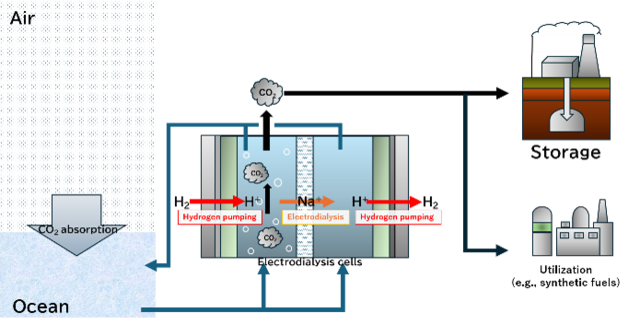
Reference 1: Outline of the Program
The Program supports early-stage research and development in frontier areas that are expected to achieve high growth in the future, with the aim of realizing a decarbonized society and creating new industries. It is expected to accelerate the social implementation of research results, including the development of technologies into national projects and the creation of startups.
Reference 2: Roles of Each Party
| GS Yuasa | Design of electrodialysis cells using fluid simulation |
| Toho Gas | Evaluation of the energy and cost of CO2 recovery for the entire system using process simulation |
| Hokkaido University | CO2 recovery experiments at laboratory scale (small scale) |
Reference 3
NEDO News Release on June 4, 2026
https://www.nedo.go.jp/news/press/AA5_101942.html
*1 DOC: Direct Ocean Capture. A technology that directly captures CO2 from the ocean, thereby reducing CO2 in the atmosphere.
*2 Electrodialysis: A technology in which electricity is passed through water to move only specific components in the water (ions) through special membranes (ion-exchange membranes).
*3 Hydrogen pumping: A technology that supplies hydrogen ions with extremely little electricity by using a small amount of hydrogen, rather than obtaining hydrogen ions by decomposing water at high voltage as in ordinary electrolysis.
*4 CDR: Carbon Dioxide Removal.


