
GS Yuasa and Osaka Metropolitan University Elucidate Moisture-Induced Degradation Mechanism in Sulfide Solid Electrolytes
November 17, 2026
GS Yuasa Corporation
GS Yuasa Corporation (Tokyo Stock Exchange: 6674; “GS Yuasa”) has elucidated the mechanism underlying the decrease in ionic conductivity of sulfide solid electrolytes upon exposure to an atmosphere containing trace amounts of moisture. The findings are from joint research with Inorganic Chemistry Group, Department of Applied Chemistry, Graduate School of Engineering, Osaka Metropolitan University.
Elucidation of this mechanism is expected to promote the development of sulfide solid electrolyte with improved moisture resistance, and manufacturing process for all-solid batteries that can suppress electrolyte degradation.
This work is being conducted supported by the New Energy and Industrial Technology Development Organization (NEDO) under the Green Innovation Fund projects (JPNP21026).
Sulfide solid electrolytes used in all-solid-state batteries have high ionic conductivity. However, exposure to air containing even small amounts of moisture can cause problems, including the generation of harmful hydrogen sulfide and a decrease in ionic conductivity. GS Yuasa has previously demonstrated that optimizing the composition of sulfide solid electrolytes can significantly suppress hydrogen sulfide generation.
The mechanism behind the decrease in ionic conductivity, however, had remained unclear, and GS Yuasa undertook research to investigate it.
The research focused on changes in solid-state NMR* spectra observed when solid electrolytes are exposed to air containing trace amounts of moisture. Using computational chemistry, the researchers simulated NMR spectra based on structural model of the solid electrolyte that accounts for the presence of moisture. By comparing the simulated spectra with those obtained experimentally, they established a method for separately evaluateing the amounts of moisture present inside and on the surface of the solid electrolyte.
Using this method, they investigated the relationship between ionic conductivity and the state of moisture in the electrolyte. They found that ionic conductivity decreases as the amount of moisture inside the solid electrolyte increases.
GS Yuasa will continue to contribute to the realization of carbon neutrality through the development of next-generation battery technologies for a range of applications, including electric vehicles.
Progress and Next Steps in All-Solid-State Battery Development
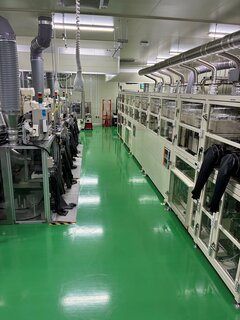
In line with the original plan for the all-solid-state battery research and development under this grant program, GS Yuasa has completed the installation of large-scale battery prototyping equipment at its Kyoto Head Office and has begun operating it. Building on the findings of this research, GS Yuasa will develop manufacturing processes for all-solid-state batteries in preparation for full-scale operation of the equipment.
Large-Scale Battery Prototyping Room
(Information)
Some of these research findings are scheduled to be presented at the following conferences:
•The 67th Battery Symposium in Japan
November 24–26, 2026 | Pacifico Yokohama North
•The 52nd Symposium on Solid State Ionics in Japan
December 14–16, 2026 | Centennial Hall, Faculty of Medicine, Kyushu University
Reference News release dated November 21, 2022:
https://www.gs-yuasa.com/en/newsrelease/article.php?ucode=gs221111535624_1241
* Solid-state NMR (Nuclear magnetic resonance) : A technique for analyzing solid-state samples using nuclear magnetic resonance. It can be used to examine the local environments of atoms in a solid.
Related Articles

Changes to the Research and Development Structure Effective April 1, 2025 —Aiming to Achieve Vision 2035 (Long-term Vision)

GS Yuasa Wins Committee of Battery Technology Award for Research Accomplishments Toward the Commercialization of All-Solid-State Batteries
GS Yuasa, Toho Gas, and Hokkaido University Launch Research and Development of Direct Ocean Capture (DOC) Using a Japan-First Technology


